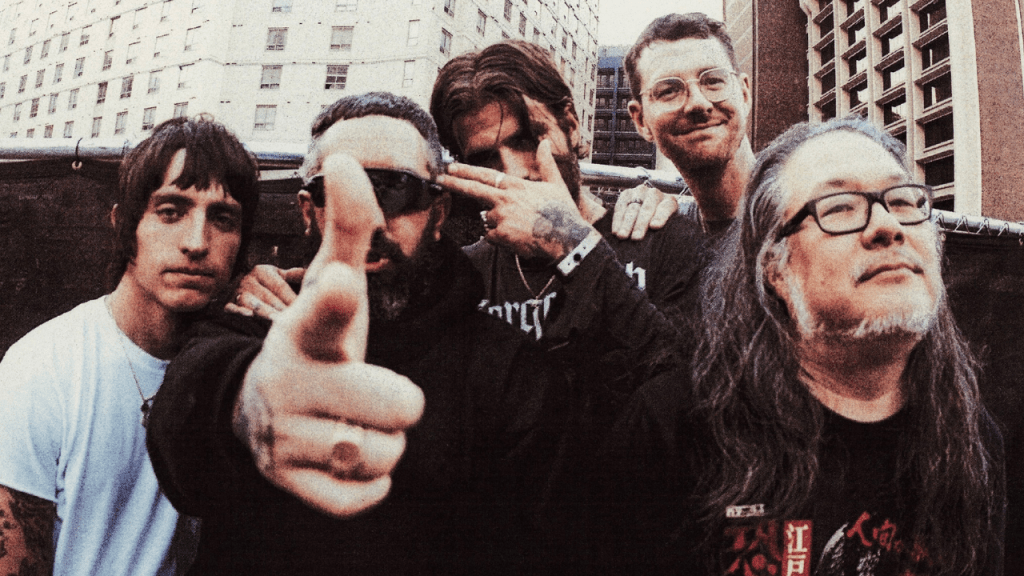
From the rattling train lines of Philadelphia’s Kensington to the isolation of Texas’ Sonic Ranch, the road to A Short History of Decay has been anything but straightforward for Nothing.
Now on their fifth studio album, A Short History of Decay (out now via Run For Cover Records/Civilians), sheds the protective haze that once cloaked the band’s heaviest moments. Vocals are drier, closer, more human. Their palette has expanded, introducing electronics, sampling and more exposed production against themes of aging, illness, mortality and the slow erosion of both body and memory. For frontman Domenic “Nicky” Palermo, the new record is less a reinvention and more of a reckoning – with time, with survival, and with the ghosts that have followed him from his upbringing through incarceration, loss, addiction and two decades of turbulence inside and outside of the music industry.
We caught up with Nicky to talk about growing up, societal re-entry, the industry burnout that followed their last album, The Great Dismal, the heaviness of time, and why A Short History of Decay feels like the clearest reflection yet of who he is – and who he’s been running from. Read his words down below.
Nothing – ‘never come never morning’
Music Feeds: You’ve had an incredibly interesting life and career leading up to now. How was music introduced to you and what role has music played leading up to you pursuing a career in it?
Nicky: I didn’t have too many luxuries growing up. I come from a pretty poor part of town in Philadelphia called Kensington. It’s kind of made its way around the internet now because of all the fentanyl users and YouTubers are walking around and doing weird shit down there.
I came from a pretty poor family, I had a typical Vietnam vet dad who was pretty violent around the house. Had a hardworking mom trying to make ends meet. And then a wild older brother and sister. So before my dad finally got out of the house and gave us a little bit of peace, it was a music-filled house always. I always look at that as being one of the lights at the end of the tunnel – the silver lining. I remember driving around with my dad and he was really into Philly soul, like Delphonics and Stylistics and stuff like that. We would drive around in his car and he’d just be listening to this stuff, I always loved that sound. Like the big strings – you can hear it in Nothing in the guitar-scapes. It’s very orchestral and I got a lot out of that.
My mom was a hippie in the 60s, and then a beatnik, and then around the time I was growing up she moved into the new wave and some of the goth stuff like Cocteau Twins and The Cure. That’s a big part of our lyrics, the beatnik times with Leonard Cohen and Bob Dylan. I had my brother who was a punk rocker, he was listening to all the New York hardcore stuff and my sister was the metalhead. So I got bombarded with all types of different music growing up, and it definitely shaped me.
It took me a while to really find myself in hardcore, I wasn’t ready for it yet. It gave me an outlet and introduced me to playing music, but I don’t think I fully understood what I wanted to say at that point. It wasn’t until I went to prison for a while and had to sit with that – and then came home, tried to re-adjust, hit rock bottom a couple more times – that things started to click. I had to go through all of that to get to a place where I could actually play the music that I thought I should be playing, which has turned out to be this, I guess.
MF: What role does your hometown, Philadelphia, play in the music that you make?
Nicky: I mean, everything. Nothing is built off nostalgia first. I’ve always been obsessed with the nostalgic side of Philadelphia – like the smell of summer when I was a kid running through the neighborhood and causing trouble, the Halloween fall and the leaves, seeing the L train go by, hearing the sounds, remembering it rattling the walls and all the photos in the house. I stayed with my grandfather for a good part of my life right in Kensington, and his apartment was kind of movie-esque with really shitty yellow wallpaper – really ratty house, smelled like cigarettes – and all the walls are covered in these cheap frames with him and all these fighters. And the train would go by, and they’d all kind of rattle. So things like that are what really trigger me. And that’s basically what Nothing always has been, a beacon for different periods of that time.
MF: You’ve had quite a storied history. You were incarcerated for a couple of years…
Nicky: Yeah, I mean it was a bad time. Coming home from that was not easy. Reintroduction into the world was hard enough. Two years might not seem like too long, but I assure you that it is. A lot of people you’re locked up with will tell you five years is the no comeback zone.
MF: Becoming institutionalised, you mean?
Nicky: Yeah, there’s certain things you just can’t shake. And there’s certain things I can’t shake, but I’ve managed to move along. Definitely some traumatic baggage, but it’s not detrimental to me moving along. Coming back alone from that is one thing, but I happened to be intercepted by a lot of extra grief around me on the outside. The world that I came home to was much different. I lost some friends and family in that short time, and I also was on parole, which in the States is kind of a revolving door. So I basically felt like I was still in there, but I was on the street. So it was taxing. I felt uncomfortable. It was hard to talk to people. It was hard to get a job. It was rough times and I didn’t really have any intention of playing music, it was more about trying to figure out what to do next. Music didn’t seem like a viable option at that point. It was like, “I need to make some money.” I was in my early 20s, no college or anything like that, I didn’t even finish high school. But I had a chip on my shoulder and I always like to prove people wrong. I don’t like hearing that I can’t do something.
I hit a second rock bottom in 2006 or 2007 and things got pretty dark for me. My good friend Josh (guitarist in Horror Show), was one of the ones who passed away, and we had all these plans of making some music and trying to make something a little bit more progressive than what we were doing with Horror Show. He got killed on a motorcycle, and that really deflated me musically. I got to this point around 2010 where I was kind of at my wit’s end and I looked toward writing again. Started with a pen and pad and progressed to some really bad demos on Garage Band in this little one-bedroom closet that I was living in in Philly. I was working in bars at that time, so I was drinking a little bit too much and coming home and not really having much to do besides trying to write a couple tunes. I put some tracks together, played them for some people at some weird, drug-fueled rage parties, and I guess I had enough people telling me that it was good to take an actual crack at it. I got together a little group of people and we put together a demo – and here we are.
MF: It sounds like survival.
Nicky: Yeah, it definitely feels that way. And looking back on it, it definitely has all the elements of just pure survival. But, you know… I was lucky enough to find something that helped me move forward, you know however painful it is, it’s still the fact that getting music together has become this therapy for me to move on. And it’s not really changed much since then – and this new record is a pure example of that.
MF: Your new album, A Short History of Decay, has been called “Nothing’s most ambitious work to date.” What inspired you to pick up the tools again after your 2020 release, The Great Dismal. Especially after saying it felt like the natural conclusion of Nothing at the time?
Nicky: Well I was definitely over the industry. COVID happened right when we released that record, and that didn’t make things easier. The label wanted us to hold out and not release it until the coast was clear to tour, but I had written a lot of that stuff almost with the intention of it being perfect for a time like that for the listener, and I was pretty adamant about releasing it during COVID. I fought with the publicist, I fought with the label and I finally got my way. They released it, and it did really well. It felt like it was exactly what I thought it was. People really clung to it because they were in this weird state of unknown with that whole thing.
It was a dark time, seeing people’s true colors and dealing with the industry as a whole. I was just tired of it, and I didn’t know what I wanted to do. We still played some shows, but I had no real intention of writing anymore – I didn’t feel like I had anything to write about. But things did ultimately slow down for me. I’ve said it a couple times in interviews, but it felt like I was moving in this car for 10 years, going 120 miles an hour and slamming into a brick wall. All of a sudden, here I am -I’m home, I don’t have a schedule, I don’t have this outlet to keep creating. I’m not busy, and I’m bad when I have too much time on my hands. That’s kind of how I’ve always found myself in trouble throughout my whole life.
I started to see things I discounted and took for granted around me – and without a distraction to stop myself from having to look at myself in the mirror, and dealing with who I am and what I’ve been running from. It was rough for a little while. I was close to hospitalization a couple times during this time and I was out there doing things I shouldn’t be doing again. In this process of trying to get myself sorted, I was going through this inner turmoil that started to open up some doors that I hadn’t opened up. All of a sudden I had this urge to start writing again and I was seeing things that felt worthwhile to build on. And then a guitar comes out, then a piano and then these shitty little demos that I do start to come to life. I talked with the gang and played them some demos that are a little crazier than what they normally expect and we talked about how we could fit them, and I was like “I don’t really want to make them sound like a Nothing song. I think they should just sound like this”. And we just ran with that, and I’m blessed to have a good team of people around me that are supportive and they trust what I’m seeing even though you can’t see it in these demos, but they want to help me get it there. So we went and we did the record, and here we are.
MF: What does this new album symbolize for you in the catalog of Nothing’s music?
Nicky: There’s so many different levels of what this one means to me. But I think the main thing is how powerful time is and how meaningful time is. It’s a pretty cliché thing for an old head to start tripping about time – you just start to see things around you and wonder about the things that are around you that you care about and that you take for granted. How long are they going to be around for you? I should be well-versed in that considering the amount of things that I lost along the way, but it grows with time. And when you start to face your own mortality you start to see your body decline, your mental state isn’t the same, you feel it when you wake up and things start to click into place. This record really symbolizes the heaviness of time for me.
MF: The recording process sounded like a very chaotic time. High-speed cruises with the studio compound owner, Tony, and alcohol-fueled recording sessions. Do you feel like this setting aided the creative process?
Nicky: It did something. I mean, everywhere we go we have this chaotic energy that follows us. You could speak to anybody who’s been in the room with us – it’s the energy that we give off. That said, Sonic Ranch was a ridiculous couple weeks. Very strange and off-putting but it’s nice being in these different settings. It’s kind of a barren off-season pecan ranch – it’s massive, no one is there, and it’s literally on the border. So we would walk to the border wall all the time and throw rocks at it, take pictures and shit. But it was just a strange place to be, being super isolated like that and having such a barren landscape, it just worked really well for the way that this record was going to be. Vocals that aren’t drenched in reverb, drier, it felt kind of appropriate where we were.
Tony, the owner, was just as crazy as us. He was a guy who made such an impact on the band Ministry. Ministry moved there for two years and lived on the ranch with them, so he’s definitely on the level. He told the producer Sonny later on that I was the craziest guy he ever met, and I was like “This can’t be the case. He was living with Al Jourgensen, there’s no fucking way. Those guys are all maniacs, what the hell did I do?”
But, yeah it was a great experience. It was just super weird and kind of Lynchian in a way. Like, “where the fuck am I at right now?” So I think the confusion that everybody was feeling really worked well into the record. We didn’t know how a lot of these songs were going to turn out because the demos were so barren and bare that there’s really no way we knew what we were going to do until we got into the studio. But I always work best when my back is against the wall. The thrill of the unknown has always been a trigger point for me. So yeah, it just worked out really well.
MF: Nothing has obviously never been shy about its change in lineup as the years have gone. And for this record, you’ve sort of employed people from Cloakroom, MSC, Best Coast and Manslaughter777. What did this new lineup bring to the sound of this album?
Nicky: Since the beginning of Nothing, it’s kind of always been a collaborative effort with me at the wheel essentially. Every person that’s played with me, they’ve all left their imprint on the project, and it’s one of my favourite things. It felt like a curse for a long time, just like many things did with this project until it made sense all of a sudden. After we lost Brandon, who I wrote more songs with than most others on Nothing’s records. It kind of gave me a little bit of freedom to be like, “Okay, I can hone in on this and make this the thing here.” I’ve never hired Nothing players based on them being players. It’s always been, “I know this person and I know that I could be in a van with them and I know I could gel with them.” The day that I have to hire people that I don’t know is the day that I won’t do this anymore. I’ve also kind of now taught myself to incorporate where I’m heading with things and who would be the right person out of these friends and constituents, who would be a good fit for this so it’s probably the most planned out lineup that I’ve ever had.
Bringing Zach in was very intentional. He’s super good with electronics and sampling and stuff like that. His other band, Manslaughter 777, and MSC are really good electronic projects and I knew I was going to be moving into that area. Not to mention he’s just a gorilla on the drums. The closest thing I can get to a Kyle Kimball, who was the life force behind Nothing for the longest time, and Zach’s a little baby gorilla. Bob Bruno from Best Coast, he’s a gearhead and he toured with us for the longest time as a drink tech. Which is basically the guitar tech, but he refused to be called that. We stay with him whenever we’re in LA so it only made sense for him to move along into bass once Christina had stepped away for Gouge Away stuff. Doyle’s been with me for a minute. He was kind of the first replacement for Brandon. Brilliant songwriter, beautiful voice, great guitar player, great songwriter and he’s a great person. Probably one of my best friends. And then I knew I wanted to bring in a third guitar player for this record, and I always wanted this thing to sound huge on stage. So I met Cam a few years ago, he was just a wee little lad, 20 years old when we first met him. And he was shooting photos for us and we started bringing him on tour to sell merch. And then he was helping me TM. And then finally, when we started this record, I was like, “grab a guitar” – he’s super pro for a young man. It’s probably the best lineup, musically, that we’ve ever been able to put together. I hope I can keep them around. I’m sick of teaching people the songs over and over again.
MF: When you finally get to bring Nothing over to Australia, are there any bands from over here that you would love to share a stage with?
Nicky: Yeah I mean there’s a ton out there. I don’t know necessarily that it all would fit. Probably a cheap answer right here, but I met all the guys from SPEED, and they’re just so fucking nice. I really like them. It would be funny to cross paths with them one day. I beat that Royal Headache record to death on tour. That’s one of my favorite Australian bands. We punished ourselves so bad with that last record in Europe on a Euro tour. Like, I don’t know that I would be able to listen to it now, honestly.
MF: With a career continuing to span over two decades, is there anything that you’ve learnt in these years that you would want to tell your former self?
Nicky: Well I probably could have done without the case for sure. I probably would have told myself to lay off that one, but there’s a valuable lesson learned in every point like that. I don’t really think like that very often. I think everything that’s happened to me has shaped me into the person that I am right now. Every embarrassing misstep, or anytime I hurt somebody that I shouldn’t have – I’d love to be able to take things back like that, but it’s a part of the growth and how I got to where I am now. I think that’s all life really is, mistakes and how you move on from them. So maybe I would have changed a couple of football bets if I had a chance. Maybe that’s it.
Further Reading
Bloom Take Us Track By Track On Their New Album, ‘The Light We Chase’
La Dispute Announce 2026 Australian Headline Tour With Special Features
New Found Glory Take Us Inside The Making Of New Album ‘LISTEN UP!’