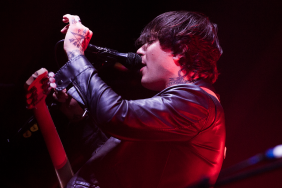
Across more than four decades, Walter Schreifels has been a defining force in hardcore, post-hardcore and alternative rock. From Youth Of Today and Gorilla Biscuits to Rival Schools and Quicksand, his fingerprints can be found across generations of underground music – including the thriving hardcore scene carrying that lineage forward today.
Now, Quicksand have opened another chapter with their fifth studio album Bring On The Psychics, their first in five years and third since returning from their lengthy hiatus. Produced and mixed by Jon Markson (Drug Church, Drain), the record bridges the bruising sound of the band’s seminal ’90s work with the more expansive experimentation of their modern era.
So who better to get Schreifels talking about it than another member of the hardcore family? To celebrate the release, Secret World vocalist Adrian Kelly caught up with the hardcore icon for a proper cross-generational chinwag spanning Quicksand’s unlikely second life, hardcore’s current renaissance, young fans discovering “the good music”, producing Title Fight, writing new “bangers” with Saves The Day and the community still connecting hardcore lifers across decades.
Quicksand – ‘Bring On The Psychics’
Quicksand 2.0
For Quicksand, the years since their reunion have increasingly become less about revisiting the past and more about figuring out exactly what the band can be in the present.
“This is the third Quicksand LP since the hiatus. I feel like that’s rarefied territory to be doing more records post-break,” Kelly observes, asking what continues to drive the band forward.
“I think with this run of records and 2.0 Quicksand, we started on an interesting platform, coming back as a band that had this sort of legacy,” Schreifels explains. “Once you break that and you’ve kind of played for everyone, there’s really not too much further to go.”
Rather than attempting to recreate what they’d already achieved on landmark ’90s records Slip and Manic Compression, the band embraced the challenge of building a new identity.
“During the course of that, we made a choice that we’re going to make a new record, knowing full well it might not make any sense with the older material. We just had to create our own aesthetic. We had pieces from our past as a reference, but we couldn’t really imitate them too well. So it was a challenge.”
That challenge ultimately became its own creative fuel. After completing their first post-reunion record and realising Quicksand had found a new rhythm together, their ambition grew.
“When we completed that second record and were all really happy, it made us feel we could dial in a better record. That got us more psyched up to do another one. When we made it, we were like, ‘Shit, we’re getting good.’”
And with Bring On The Psychics, Schreifels feels the band have finally arrived at a place they never quite reached during their original run.
“With this new one, I feel that even more. We really dialled in a lot more. We had a much stronger sense of who we are and what we wanted to do. That’s something we never really got to do the first time around because we only made two records.”
“Doing three records is sort of a special milestone. Your first record is all your first ideas, your second record is trying to bounce off that, and your third one is usually where you find yourself. I’d never really done that with a band because I’d always had a lot of different projects going. It was very satisfying, and we’re freaking stoked.”
Finding The Quicksand Sound
Kelly reflects on how much Quicksand’s latter-day output has resonated with him, naming Distant Populations as one of his favourite records from the band, behind only Slip. With Schreifels juggling enough musical projects to require, as Kelly jokes, potentially “two hands” to count, he asks how the songwriter knows when an idea specifically belongs to Quicksand.
“I have quite a few,” Schreifels concedes. “But with Quicksand, what’s really awesome is that we all actually live in New York. We’re a real band. We have a practice space and we just go in there and jam.”
“When we’ve got around 20 ideas we’ll sit together and listen to them, rate them and think about which are the best ones. From doing that, we’ll realise there are two or three different versions of the same type of song. Then we’ll vote again and work out which one really deserves to be there, so every song has a place on the record.”
Rather than heading into the process with a rigid blueprint, Schreifels says the album gradually tells the band what it needs.
“As that’s taking shape, it inevitably starts to inspire other ideas and there’ll be moments where we think it sounds like a record, but there’s something missing. You get lucky sometimes. You’ll write a few songs right at the end that push everything over the line. That’s really how this record came together.”
That confidence has been hard-earned.
“The first reunion record was hard because we just really didn’t know what we were doing.”
“Like a standing start, but with history,” Kelly offers.
“Exactly,” Schreifels replies. “We couldn’t really dial in a sharp aesthetic. We were more asking ourselves, ‘Do we all think this is great?’ Now I feel like we have a lot more gears and tools in the toolbox. It took these experiences to get there.”
Coming Home To Equal Vision
Bring On The Psychics also marks another change for Quicksand, with the album arriving as their debut release through Equal Vision Records/Civilians following two records with Epitaph.
For Schreifels, though, the move feels less like entering unfamiliar territory and more like coming home.
“I’ve known the guys from Equal Vision from the jump. I’ve been friends with Steve Reddy, who started it, for over 30 years,” he explains.
“We had a great run with Epitaph, but I think Equal Vision is really making some moves in our landscape. I felt like we were a little out of place on Epitaph, although they were really great. Equal Vision just feels a little bit more like home. Hot Water Music is there now. Sparta is there. I feel like we have a lot of peers on the label.”
Walter Schreifels Has Been Writing “Bangers” With Saves The Day
Of course, Quicksand represents just one corner of Schreifels’ sprawling musical universe.
Beyond his own bands, he’s remained deeply embedded in the wider alternative and hardcore community through songwriting, collaboration and production. And when Kelly raises rumours that Schreifels has recently been working with Saves The Day, he happily confirms there’s some truth to the whispers.
“I did some writing with them. They came up to my place in upstate New York and we wrote some songs. They’re fucking awesome.”
As for what exactly might become of those songs? Schreifels isn’t about to ruin anybody’s surprise.
“I don’t want to blow whatever their plans are, but yeah, we did some work together. They took me out on tour years ago when I was doing solo acoustic stuff and we’ve always had a great relationship.”
“They wanted to make some new songs, so I invited them up and we got some bangers out of it.”
The Kids Are Discovering “The Good Music”
That naturally leads the pair into Schreifels’ production work, which has included records from Hot Water Music, Civ and Gogol Bordello, as well as Title Fight’s beloved Shed.
Kelly raises one of the stranger – and arguably coolest – quirks of the streaming era: young listeners discovering underground records released years or even decades before they were born, sometimes turning deep cuts into unlikely viral hits. Title Fight’s Shed track ‘Safe In Your Skin’ is one such example.
Schreifels has a beautifully simple term for what’s happening.
“That’s ‘the good music’.”
“I have an 18-year-old daughter, my niece is 16 and my nephew’s 13. They’re discovering ‘the good music’. Obviously there are lots of great young bands too, but I was influenced by bands from the 1960s and continue to be influenced by them. It’s really nice that the bands I came up with still resonate with people, especially my own music.”
And for Schreifels, the renewed interest in hardcore feels particularly significant because of what the culture represents beyond the songs themselves.
“It’s amazing to see what’s happened with hardcore – not just its popularity, but its cultural significance. It’s not advertising music, you know what I mean? It’s more community-based and it has a set of ethics connected to it. That’s how I got into all of this.”
What’s Walter Schreifels Listening To In 2026?
The musical exchange between generations isn’t only flowing in one direction.
Asked by Kelly what newer music has been occupying his ears, Schreifels reels off a gloriously eclectic listening list.
“I really love the recent Hayley Williams record, it’s really great. And a solo artist named William Cashin, he plays bass in New York in Future Islands but he has a solo album called Postcard Music, it’s very ambient.”
“Drug Church’s recent record – Health. Corey Hanson, he was in a band called Wand that I also like. I’m into the new Fiddlehead record, and new Basement is really good as well, which is kind of adjacent to Fiddlehead.”
That exchange happens within Schreifels’ own family too.
“My nephew will [put me onto music] from time to time. My daughter, I’ll hear her in the other room and I’ll ask what she’s listening to. She turned me on to Always, the band. Female vocalist from Canada I think. The melodies are amazing so she got me into them, but I turned her on to David Bowie so I think we’re still at a deficit.”
Meanwhile, his own catalogue has become part of their musical education.
“They’re into my stuff. My daughter’s favourite is Walking Concert. I made an album called Run To Be Born – that’s her favourite.”
“My nephew is very hip to music, I remember with Quicksand we played this Slip anniversary show and I saw him on top of the crowd, crowd surfing. He always goes to the shows, he was at the recent Gorilla Biscuits shows in New York. My nephew’s a musician. He’s very into all of it.”
The Records That Made Walter Schreifels
Of course, for a musician whose own catalogue has become formative listening for generations of hardcore artists, we couldn’t let Schreifels escape without turning the question back on him.
What are the hardcore records that he considers essential?
“I’m just going to go with what shoots into my head. Agnostic Front’s Victim in Pain, Negative Approach’s Tied Down, and Minor Threat’s discography. Out Of Step if I have to choose, or their first two 7”.”
“Dead Kennedys’ Fresh Fruit For Rotten Vegetables and Adolescents’ Return to the Black Hole.”
Hardcore Across Generations
More than four decades into his life in music, Schreifels’ appetite for touring hasn’t exactly diminished either.
“I’ve been touring more because there’s been more demand. I try to do it in little bits, but my year will be pretty full up until the summer of 2027 right now. I love it.”
“I just did another trip around the world this past month. I love playing for different people, I love my friends around the world, and the experiences that I get from touring are really nourishing for me.”
And it’s here that the cross-generational nature of Schreifels and Kelly’s conversation comes full circle.
Kelly recalls seeing Gorilla Biscuits play a small room in Australia, before later catching them in Brooklyn alongside Bouncing Souls and a then-ascending Turnstile.
“You had people come out to actually perform the trumpet intro – I couldn’t believe it,” Kelly remembers. “Unbelievable stuff. Then people started diving to the trumpets… You’re probably seeing that every day, but I was shocked.”
Years later, Kelly would watch another friend from Australia’s current hardcore generation put his own spin on that tradition.
“And then to see my friend Jem in SPEED doing the intro, but on his flute, that was so special seeing that, we were all losing our minds.”
It’s a neat little snapshot of what keeps hardcore moving: traditions inherited, mutated and passed along from one generation to another, without becoming museum pieces in the process.
And Schreifels is seeing that energy everywhere.
“Hardcore is off the chain all over the world right now. Youth of Today just played in Detroit, we played a festival called Tied Down and it was one of the best shows we’ve ever played, it was incredible. I think that was as good as hardcore gets.”
“And then we played again at a festival in Eastern Germany a couple of weeks ago and it was absolutely fantastic. Every place has its different thing. Like people in South America go fucking bananas, it’s insane.”
Ultimately, for someone who has watched hardcore evolve across more than four decades – and helped shape several of those evolutions himself – Schreifels sees the scene’s current strength as proof of something much bigger than another revival cycle.
“Generally the scene is very strong everywhere. There’s a demand for Youth of Today, Gorilla Biscuits and Quicksand.”
“It’s just wonderful to have that connection – that intergenerational thing that we’re all pulled together by. I think it’s really wonderful.”
Bring On The Psychics is out now via Equal Vision Records/Civilians.
Further Reading
Fleshwater Announce 2026 Australian Tour With Ingrown & Secret World
Rise Against Are Returning To Australia With Dropkick Murphys For Huge 2026 Tour
Secret World Announce New EP ‘Tomorrow Is A Mystery To Me’, Share Shogun Collab