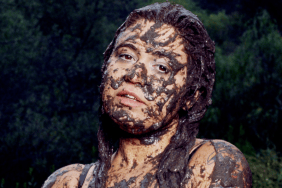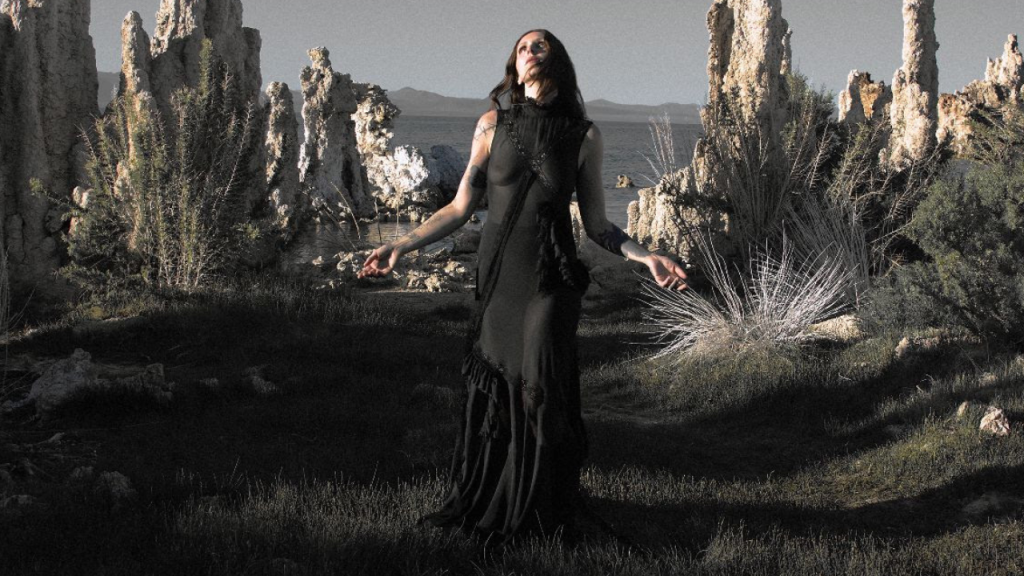
Chelsea Wolfe has spent her career finding beauty in the shadows, but on her ninth studio album The Dark, the acclaimed musician, songwriter and multidisciplinary artist isn’t simply venturing into the darkness – she’s learning how to become it. Out today via Loma Vista Recordings, the 10-track LP draws on the idea of entering the woods at their darkest point and becoming the thing you fear in order to move through it, weaving together themes of letting go, reclaiming personal power, grief, spirituality and the afterlife.
Created alongside co-writer Jennifer Decilveo and longtime collaborator Ben Chisholm, The Dark finds Wolfe deliberately stripping back some of the sonic layers surrounding her songwriting, while enlisting a formidable cast of players including Nine Inch Nails’ Robin Finck, Pearl Jam’s Matt Chamberlain, Queens Of The Stone Age’s Troy Van Leeuwen, Warpaint’s Stella Mozgawa and Justin Meldal-Johnsen. From the visceral release of Cold and Humours to the séance-like self-reclamation of Turn The Key and the meditations on death and ancestral connection that close the record, its darkness ultimately carries an undercurrent of survival and transformation.
To mark the arrival of The Dark, Wolfe has blessed Music Feeds with an intimate track-by-track tour through the record, unpacking the memories, relationships, mythology, films and personal reckonings that shaped each of its 10 songs. Read her full guide below.
Chelsea Wolfe: The Dark Track-By-Track
1. Cold
“Cold was the first song that we wrote for the record and it was sort of the deciding factor of the direction The Dark was going to go in sonically. It’s probably the most direct and straightforward song on the record as well which is why I wanted to put it first and just start the record off with this very direct message of: I’m letting you go. So much of this album is about letting go and exploring the different ways that we have to do that in our lives.”
2. Seethe
“I think I started writing Seethe on a ferry boat in Scandinavia. I was in the middle of a European tour and feeling very inspired. And I actually wrote it on bass, which I don’t normally do, and it’s why I think it sounds pretty different from everything else because it started life a lot differently to how I normally write. I wanted it to have a very driving, forward motion type of feeling, like a train going off the tracks or something a little bit wild. I chose to start it on bass for that reason and build from there. And it’s an ode to the character of the female serial killer and/or the female assassin in film and TV and books and real life.”
3. Humours
“I think this is the most emotional song on the record. It took the most work to get this song right, I rewrote the chorus multiple times. The driving pop chorus just was not feeling right for this song so I took it back to my acoustic guitar and really just dug into a slower, more deeply emotional chorus that ended up feeling really right for it. And it’s actually my favorite one to perform now. Something about Humours just feels very freeing. The lyrics are talking about getting free from someone who wants to hold you all to themselves and take all of your talents and your power for their own use instead of allowing others to take part in it. It’s a heavy song for me and it has a lot of emotional intensity and haunting memories. But because I was able to get free from that situation and write about it, it feels really good to sing.”
4. Swallower
“This one has a bit of a subtle mythological bent. I was thinking about the mythological character of the Troll and how they can’t go out into sunlight or else they’ll turn to stone. And obviously that’s where we come up with the modern day concept of the internet troll who just sort of hides in the dark. It’s a little bit cheeky, this one. And when I was looking back at the root of the word “troll” or the etymology of this sort of mythological character, I was looking at Nordic mythology and there was this poem that spoke about the Troll, the Swallower of the Wheel of Heaven [hvélsvelg himins]. To me, that was such a beautiful way of putting it. And it’s very true to someone who is a troll and just literally has no light to them and is just swallowing the beauty of heaven. I thought it was very dramatic and fun and cheeky to call this song Swallower after reading that.
I also love the imagery of the well. It’s such a mysterious thing that we’re sort of drawn to, it could be a portal and so many other things. With this one, I was thinking about the Haruki Murakami book The Wind-Up Bird Chronicle, and the well becomes this sort of portal space in that book. I drew on moments where it literally feels like you’re getting dragged down into someone’s bottomless well, this feeling that you’re pouring all of your energy into someone else’s bottomless pit and realising that they’re never going to take the reins and stand in their own life. And for me, I had to be like: I’ve got to pull my power back. You realise nothing you give will ever be enough for this person, so to change that, I’m not going to be there at all.”
5. Halo
“This is kind of a post-apocalyptic love story in a song. And because of that, I wanted to keep the instrumentation really stripped down. It’s pretty close to the demo version actually. This is one of the ones I did in a writing session, prior to working with Jen [Jennifer Decilveo, co-writer], and I just loved the feel of it. The title of the record comes from the concept of the “Dark Night of the Soul”. And somehow this song feels very much like a dark night of the soul. I also actually wrote the lyrics for Halo after watching the first season of The Last Of Us. It’s about having to do difficult things in order to save the one that we love.”
6. The Dark
“I felt like it was important to put this song out there first to establish this little world that we were going to be creating with the album. One of the main themes of the album is: be the darkest thing in the woods. I love that imagery of owning your power and not being scared anymore, becoming the scary thing to overcome whatever it is that you need to overcome. It’s about being okay being seen as the villain in someone else’s story when all you’re really trying to do is just set boundaries and move forward in your life, or at the bare minimum, just take care of yourself. It’s funny how simple all of these things seem, but in reality they’re not.”
7. Turn The Key
“This song has the most seance-themed imagery in the lyrics. I keep thinking of it as a seance for my own soul. And after a long period of self-abandonment, it’s really about calling myself back to myself. I hope that it can be like that for other people too. The lyrics, “show me where you are”, it’s really about trying to find yourself again, but at the same time, finding the current version of who you are. Something about this record feels very much like a return to form of maybe even 20 years ago for me. But at the same time, it’s totally also who I am now.
I wanted to give Turn The Key a heavier feel because in the chorus, I’m a little bit fed up, I say I erased myself. And in the moment that I wrote this, I was like: I’m not letting any new people into my life because I’m so tired of having these relationships where I end up giving myself away over and over, and trying to change who I am to fit this person’s needs. It’s not necessarily the healthiest stance to take, but that’s just how I was feeling in the moment of writing that. I was just like: I’m done!”
8. I’m Not There
“I wrote a lot of I’m Not There in a period of time where I was honestly dealing with some depression and dissociation and having that literal feeling that I was disappearing. When I wrote that first verse, I was not in the greatest state. I think it could be interpreted in a lot of different ways, but for me, it was really about literally dissociating and realising how much I had been numbing out in order to be in a relationship with a certain person. The chorus is sort of that push and pull between thinking that I’m brave enough to leave and then getting pulled back in when the other person says all the right words and says that they’re going to change for me. On the previous song, Turn The Key, it’s like: I’m changing for you. And it’s definitely this very intertwined, codependent relationship that is coming in and out of a lot of the songs on this record, I’m exploring it in different ways. I’m Not There was a bit heavier. But by the end of the song, I’m feeling a little bit stronger. I’m saying: I’m not scared anymore, I don’t want to keep doing this, I’m done. This record is very heavy and very dark, but it’s also written from a point in my life where I was ready to do something about it. So it’s actually kind of empowering.”
9. Death Is Not The End
“These last two songs on the record have a little bit of a different feel and subject matter. Death Is Not The End and Dancer In The Sky more directly deal with the afterlife and exploring that, and exploring ancestral lineage and things like that too. Spending more time with my grandmother, who’s in her late 80s, after not speaking for over 20 years and getting to reconnect with her as an adult has been a really meaningful thing for me in the past few years. And I channeled exploring my connection with my great-grandmother and my great aunt who have passed on through a personal seance ritual into Death Is Not The End. It also explores concepts of the afterlife, and knowing that I don’t know what comes after death. I personally don’t believe that death is the end and I do believe that energy continues and I hope that it’s something beautiful. For the imagery, I was exploring the myth of the Selkie, which is about a seal woman who gets entrapped on land by a man taking her seal skin. As a result , she has to live as a human woman for a time and have children with this man. But eventually she finds her seal skin again and she just has to return to the sea. As difficult as it is, that theme of letting go again, she has to leave her earthly children behind, and maybe other people that she loved there too. But she just has to return to the sea because that’s her true nature. I felt like that was a really beautiful representation of a lot of what I was singing about on this record. And it also does feel like this sort of life/death story which is perfect for this song.”
10. Dancer In The Sky
“Some of the things I mentioned previously, exploring and honouring my matriarchal lineage who have passed on and trying to connect with them, I put a lot of that into this song. The song is also about grief and looking for signs of those we loved who have passed on, whether it’s when you look up and see those clouds that almost look like they’re dancing in the sky, or whether it’s a butterfly or a bird or just something fleeting that feels like you can sense that person that you loved in that moment. It’s such a simple thing on paper. But when you feel that it’s so powerful. This song is also really inspired by the film What Dreams May Come from the early 2000s, which has always been a favorite of mine. It’s literally about the afterlife and reaching into different dimensions of the afterlife to save the one that you love. That’s another big theme of this record, and Dancer In The Sky gives an ode to that movie.”
Chelsea Wolfe’s ninth LP ‘The Dark’ is out now via Loma Vista Recordings
Further Reading
Chelsea Wolfe Returns With New Album ‘The Dark’ And An All-Star Cast Of Collaborators
Queens Of The Stone Age Announce Australian Tour, Drop First New Song In Three Years